
Vertical Blinds for Large Glazing: Where They Still Beat Every Alternative
Vertical Blinds for Large Glazing: Where They Still Beat Every Alternative
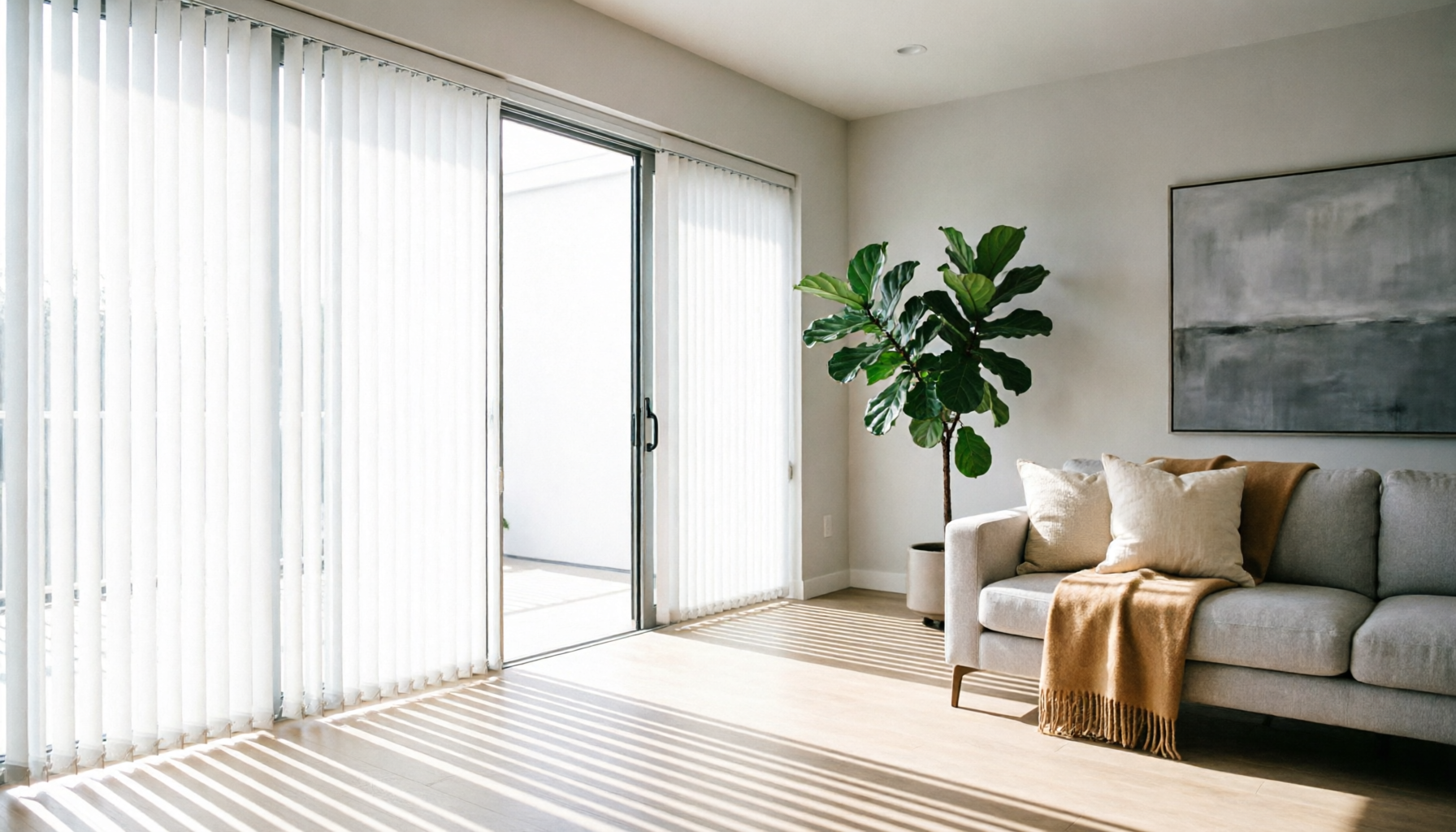
Short answer: vertical blinds have a dated reputation in residential interiors and remain the default in offices, and the reason is mechanical rather than aesthetic. On very wide openings, a vertical system carries its weight along a horizontal track rather than lifting it — so the operating effort does not grow with the drop, the stack sits neatly to one side, and a damaged component is a single replaceable louvre rather than a whole blind. For floor-to-ceiling glazing and wide sliding doors, no horizontal product matches that combination.
### The mechanical argument
A horizontal blind or shade lifts its entire weight vertically. As the drop increases, the load on the mechanism increases, the stack at the top grows, and the operating effort rises — which is why tall windows push quickly towards motorisation.
A vertical blind hangs its louvres from carriers that traverse a track. The consequences:
- Operating effort is largely independent of drop. A 3-metre-tall vertical blind traverses no harder than a 2-metre one.
- The stack is lateral. Louvres gather at one or both ends, clear of the glass, rather than piling at the head.
- Component-level repair. A stained or damaged louvre is replaced individually — a decisive maintenance advantage across a building with hundreds of windows.
- Sliding doors work naturally. The blind traverses in the same direction as the door, so the opening can be used without raising anything.
### Where verticals are the right specification
- Offices with continuous glazing — repairability and cost per square metre dominate, and the stack behaviour suits mullion spacing.
- Wide sliding or patio doors — traversing beats lifting when the opening is used daily.
- Floor-to-ceiling residential glazing — where a roller of the same size would be heavy, expensive and slow.
- Rooms needing directional light control across a wide span — louvres rotate to cut low-angle sun from the side, which a roller cannot do at all.
- High-turnover rental and student accommodation — replaceable louvres reduce lifecycle cost.
### Where they are the wrong specification
- Small windows — the track and stack are disproportionate.
- Rooms where full darkness is required — verticals leak between louvres by design; a blackout roller with channels is the answer.
- High-end residential where the look is the brief — this is a legitimate reason to choose something else, and it is the main reason verticals lost the domestic market.
- Very windy openings that are left open — louvres swing and clatter; consider a different product or a chain-weighted specification.
### Specification details that separate good from poor
#### Louvre width
The common widths are 89mm (3½") and 127mm (5"). Narrower louvres give a finer appearance and a smaller stack; wider louvres reduce the number of components on a large run and read as calmer across long façades.
#### Track and carrier quality
This is where cheap systems fail. Ask about:
- Carrier material and spacing — plastic carriers on a long run are the usual failure point.
- Wand versus cord/chain operation — wand control is the child-safe default (see the cord safety standards for interior blinds).
- One-way or split draw — split draw stacks to both ends and halves the stack width at each side.
- Track curvature — bay windows and curved façades need a curved track; confirm the minimum radius.
#### Bottom chains and weights
Chain-linked bottoms keep louvres aligned and reduce swing in draughty spaces, and are standard in commercial installations. In some environments (schools, healthcare) chainless with individual weights is specified instead for safety reasons — check the project requirement.
#### Fabric versus PVC louvres
- Fabric louvres — better acoustics and appearance, wider colour range, can be specified in FR fabric for contract projects.
- PVC louvres — wipe-clean, humidity tolerant, better in kitchens, labs and healthcare.
- Blackout-lined louvres — reduce transmitted light substantially but do not eliminate the gaps between louvres.
### The acoustic point most specifications miss
Large glazed offices have a hard-surface acoustic problem. Fabric vertical louvres, presented face-on across a wide window, add a meaningful area of soft surface — one of the few window treatments that contributes usefully to reverberation control simply by covering a large area. Where acoustics are part of the brief, this is a genuine argument for fabric louvres over PVC or over a small-area treatment.
### What to ask any supplier
1. "What louvre widths are available, and what is the stack width at my opening size?" — stack width determines whether the glass is really uncovered when open.
2. "What is the carrier material, and what is the track's maximum recommended run before a split?"
3. "Is the operation wand, chain or motorised, and does it meet the child-safety standard for my market?"
4. "Fabric or PVC, and is an FR-certified fabric available?" — required for contract work.
5. "Are bottom chains standard, and can they be omitted where the project requires?"
6. "How are individual louvres replaced, and are replacements available from stock in five years?" — the whole lifecycle argument depends on this answer.
7. "For curved or bay runs, what is the minimum track radius?"
### Frequently asked questions
Are vertical blinds outdated? Aesthetically they fell out of residential fashion; functionally they remain the most practical solution for wide and tall glazing, which is why offices never abandoned them. If the brief is a large opening and low lifecycle cost, they are the rational choice.
Do vertical blinds block heat? They reduce solar gain when rotated closed, and a reflective or light-coloured louvre helps — but like all interior products they intercept energy only after it has passed the glass. For heat control, exterior shading remains far more effective.
Can they be motorised? Yes, traverse and tilt can both be motorised, and it is common on high or inaccessible commercial glazing. Motorised tilt alone is a lower-cost middle option.
What about the gaps between louvres? Inherent to the product. Overlapping louvre profiles reduce them; they never eliminate them. If darkness is required, specify a different product.
Written by the engineering team at GRAND HOMEDECOR (Guangdong Grand Homedecor Technology Co., Ltd.). Louvre widths, track runs, stack dimensions and FR fabric options for our vertical blind range are confirmed against project drawings at quotation.
Related Products
Plantation Shutters
Premium hardwood shutters for living rooms and bedrooms with adjustable light control.
Roller Blinds
Minimalist roller shades with blackout, sunscreen, and sheer fabric options.
Honeycomb Shades
Energy-efficient cellular shades with superior thermal insulation.
Need Help Choosing the Right Window Treatment?
Our team can help you select the best products for your project. Get a free consultation or request a sample today.