Commercial Window Treatments for Hotels: A Specification Guide
Commercial Window Treatments for Hotels: A Specification Guide
Hotels have some of the most demanding requirements for window treatments. Guest rooms need reliable blackout, public areas require aesthetic consistency, and every product must meet fire codes and withstand high-cycle use. This guide helps architects, interior designers and procurement teams specify the right products for each hotel zone.
Understanding Hotel Requirements
### Fire Safety Codes Commercial window treatments must meet local fire regulations. In the US, NFPA 701 is the standard test method for flame propagation. In Europe, EN 13773 and BS 5867 Part 2 apply. Always request test certificates from suppliers and verify they match your jurisdiction's requirements.
### Blackout Performance Guest satisfaction in hotels is directly tied to sleep quality. A true blackout solution should achieve less than 1% light transmission. This requires not just blackout fabric, but also side channels, headboxes and bottom seals to eliminate light gaps.
### Durability and Cycle Life Hotel blinds may be operated 4-6 times daily. Commercial-grade products are rated for 10,000+ cycles. Residential products rated for 5,000 cycles will fail prematurely in hotel use.
### Maintenance and Cleaning Housekeeping staff need products that are easy to clean and resistant to stains. Removable, machine-washable fabrics or wipe-clean surfaces are essential.
Product Selection by Hotel Zone
### Guest Rooms **Primary need**: Blackout for sleep quality.
**Recommended products**: - **Blackout roller blinds with side channels**: The most cost-effective solution. Aluminum side tracks eliminate light gaps. Choose fabrics with a white backing to reflect heat and maintain a consistent exterior appearance. - **Dual roller systems**: A sheer roller for daytime privacy and a blackout roller for night. Both operate independently on a single headrail. - **Plantation shutters**: Premium option for upscale properties. Basswood or PVC shutters provide excellent light control and a high-end aesthetic.
**Key specifications**: - Fabric: 100% polyester blackout, NFPA 701 certified - Operation: Chain drive with safety breakaway, or motorized for upscale properties - Side channels: Aluminum, color-matched to fabric - Bottom bar: Weighted, with brush seals
### Corridors and Public Areas **Primary need**: Aesthetic consistency and durability.
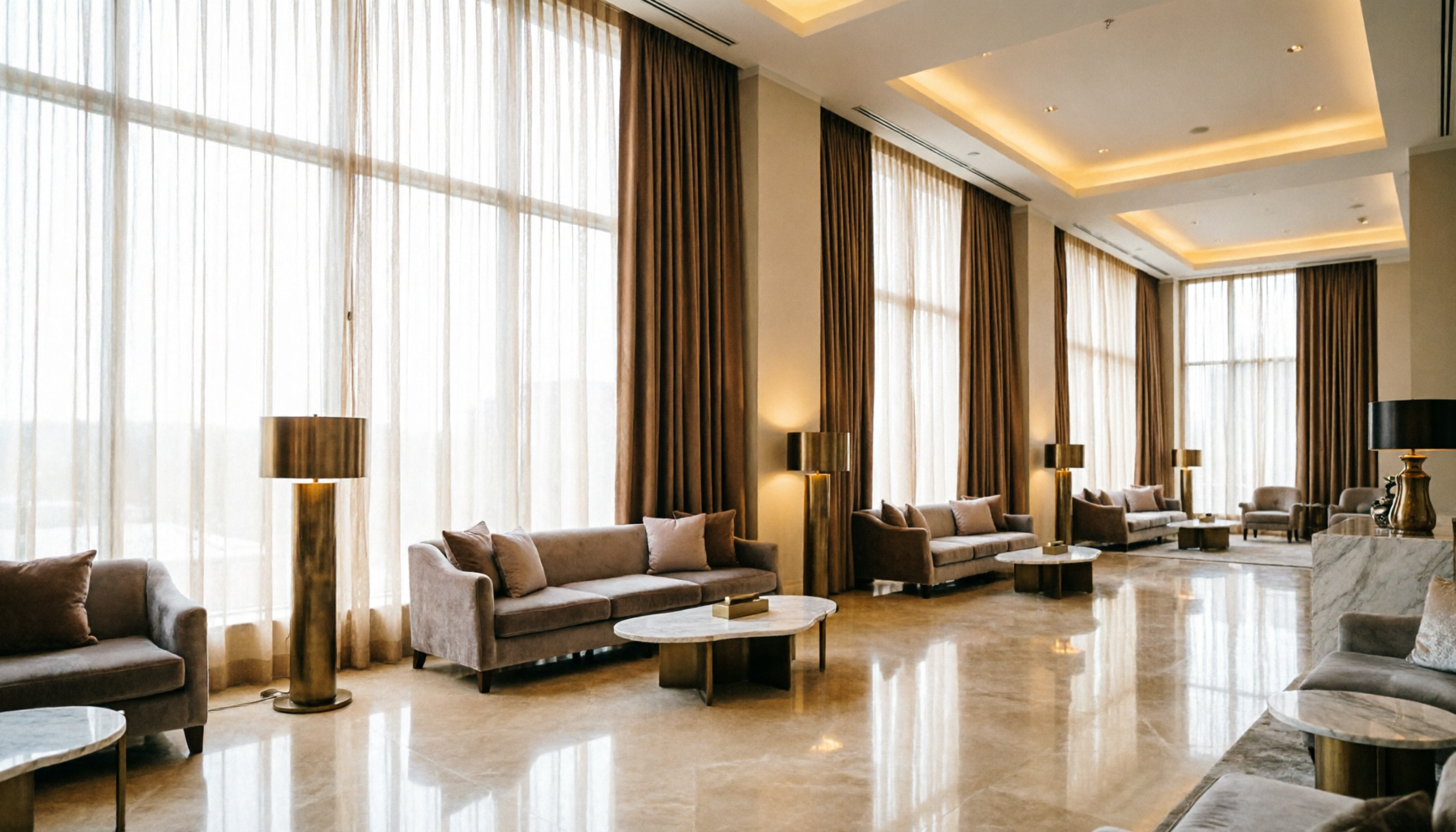
**Recommended products**: - **Solar screen roller blinds**: Reduce glare and UV while maintaining outward visibility. Choose 3-5% openness factor for corridors. - **Vertical blinds**: Practical for large windows and sliding doors. PVC vanes are easy to clean and replace individually. - **Panel track systems**: Ideal for floor-to-ceiling windows in lobbies and conference rooms.
**Key specifications**: - Fabric: Fiberglass or polyester screen, UV-stabilized - Fire rating: NFPA 701 or local equivalent - Operation: Wand or motorized for high windows
### Conference and Meeting Rooms **Primary need**: Flexible light control for presentations.
**Recommended products**: - **Dual roller systems**: Sheer + blackout combination allows presenters to adjust ambient light without losing all natural light. - **Motorized systems with scene control**: Preset positions for "presentation mode," "video mode" and "daylight mode."
**Key specifications**: - Motor: Quiet operation (< 40 dB), with manual override - Control: Wall keypad + remote + optional BMS integration - Fabric: Dimout or blackout, depending on room function
### Restaurants and Bars **Primary need**: Atmosphere control and glare reduction.
**Recommended products**: - **Solar screen blinds**: Reduce glare on tables while maintaining views. - **Sheer curtains**: Soften light and add acoustic dampening. - **Wooden venetian blinds**: Warm aesthetic for upscale dining areas.
**Key specifications**: - Fabric: Screen or sheer, easy to clean - Finish: Moisture-resistant for bar areas - Operation: Manual or motorized depending on ceiling height
### Spa and Pool Areas **Primary need**: Moisture resistance and privacy.
**Recommended products**: - **PVC roller blinds**: Fully waterproof, easy to clean. - **Aluminum venetian blinds**: Corrosion-resistant, suitable for humid environments. - **PVC plantation shutters**: Waterproof, no warping or mold growth.
**Key specifications**: - Material: PVC, aluminum or synthetic wood only. No natural timber. - Finish: Powder-coated or anodized for corrosion resistance - Operation: Wand or motorized (avoid corded systems in wet areas)
Specification Checklist
When writing your specification document, include:
- [ ] Fire certification (NFPA 701, EN 13773, BS 5867 Part 2 or local equivalent)
- [ ] Blackout performance rating (light transmission percentage)
- [ ] Cycle life rating (minimum 10,000 cycles for commercial use)
- [ ] Fabric composition and cleaning instructions
- [ ] UV stability rating (for sun-facing facades)
- [ ] Motor specifications (if applicable): voltage, noise level, warranty
- [ ] Side channel and sealing details (for blackout applications)
- [ ] Color fastness rating (minimum 4/5 on the grey scale)
- [ ] Warranty terms (minimum 3 years for commercial products)
- [ ] Spare parts availability (vanes, bottom bars, motors)
Common Mistakes in Hotel Projects
1. **Specifying residential products**: They look identical but fail within 12-18 months in commercial use. Always verify cycle ratings. 2. **Ignoring side channels**: Blackout fabric alone cannot achieve true darkness. Light leaks around the edges ruin the guest experience. 3. **Forgetting maintenance access**: Motors and mechanisms need periodic service. Specify accessible headboxes and removable covers. 4. **Mismatched exterior appearance**: From the street, all blinds should look consistent. Specify white or neutral backing on all fabrics. 5. **Skipping mock-ups**: Always install a sample in a typical room before full procurement. Test blackout performance at different times of day.
Budget Planning
| Product Type | Price Range (USD per m²) | Typical Lifespan | |--------------|--------------------------|------------------| | Blackout roller with side channels | $80 - $150 | 8-12 years | | Dual roller system (sheer + blackout) | $120 - $200 | 8-10 years | | Motorized roller with remote | $200 - $350 | 10-15 years | | PVC plantation shutters | $150 - $250 | 10-15 years | | Basswood plantation shutters | $250 - $400 | 15-20 years | | Vertical blinds (PVC) | $60 - $100 | 5-8 years | | Solar screen roller | $70 - $120 | 8-10 years |
Prices vary by region, order volume and customization. Request quotes from 2-3 suppliers for comparison.
FAQs
### What fire certificate do I need? This depends on your location. In the US, NFPA 701 is standard. In the UK, BS 5867 Part 2. In the EU, EN 13773. Always verify with your local fire marshal or building inspector.
### Can I use curtains in hotel rooms? Yes, but they must meet fire codes and be professionally cleaned regularly. Many hotels use a combination of roller blinds (for blackout) and decorative curtains (for aesthetics).
### How often do hotel blinds need replacement? With commercial-grade products and proper maintenance, 8-12 years is typical. Budget for a refresh cycle in your capital expenditure plan.
### Should I motorize all guest room blinds? Not necessarily. Battery-powered motors add cost and require recharging. Consider motorizing only high or hard-to-reach windows, and use chain drive for standard heights.
Conclusion
Hotel window treatments are a critical component of guest satisfaction and operational efficiency. Specify commercial-grade products with proper fire certification, plan for maintenance access, and always test samples in situ before full procurement. The upfront cost of quality products is offset by their longer lifespan and reduced replacement frequency.
Related Products
Plantation Shutters
Premium hardwood shutters for living rooms and bedrooms with adjustable light control.
Roller Blinds
Minimalist roller shades with blackout, sunscreen, and sheer fabric options.
Honeycomb Shades
Energy-efficient cellular shades with superior thermal insulation.
Need Help Choosing the Right Window Treatment?
Our team can help you select the best products for your project. Get a free consultation or request a sample today.