
Why 'Blackout' Blinds Still Leak Light — and How to Actually Achieve a Dark Room
#### Why "Blackout" Blinds Still Leak Light — and How to Actually Achieve a Dark Room
Short answer:"blackout" describes the fabric, not the installation. A blackout fabric blocks essentially all light through its own surface, and then light arrives anyway through four paths the fabric has nothing to do with: the gaps at each side, the gap at the top around the roller or headrail, the gap under the bottom bar, and — in hotels especially — the join between two blinds or between blind and wall. Achieving a genuinely dark room is a detailing exercise: fabric choice is the easy 20% of it.
### The four light paths
#### 1. Side gaps
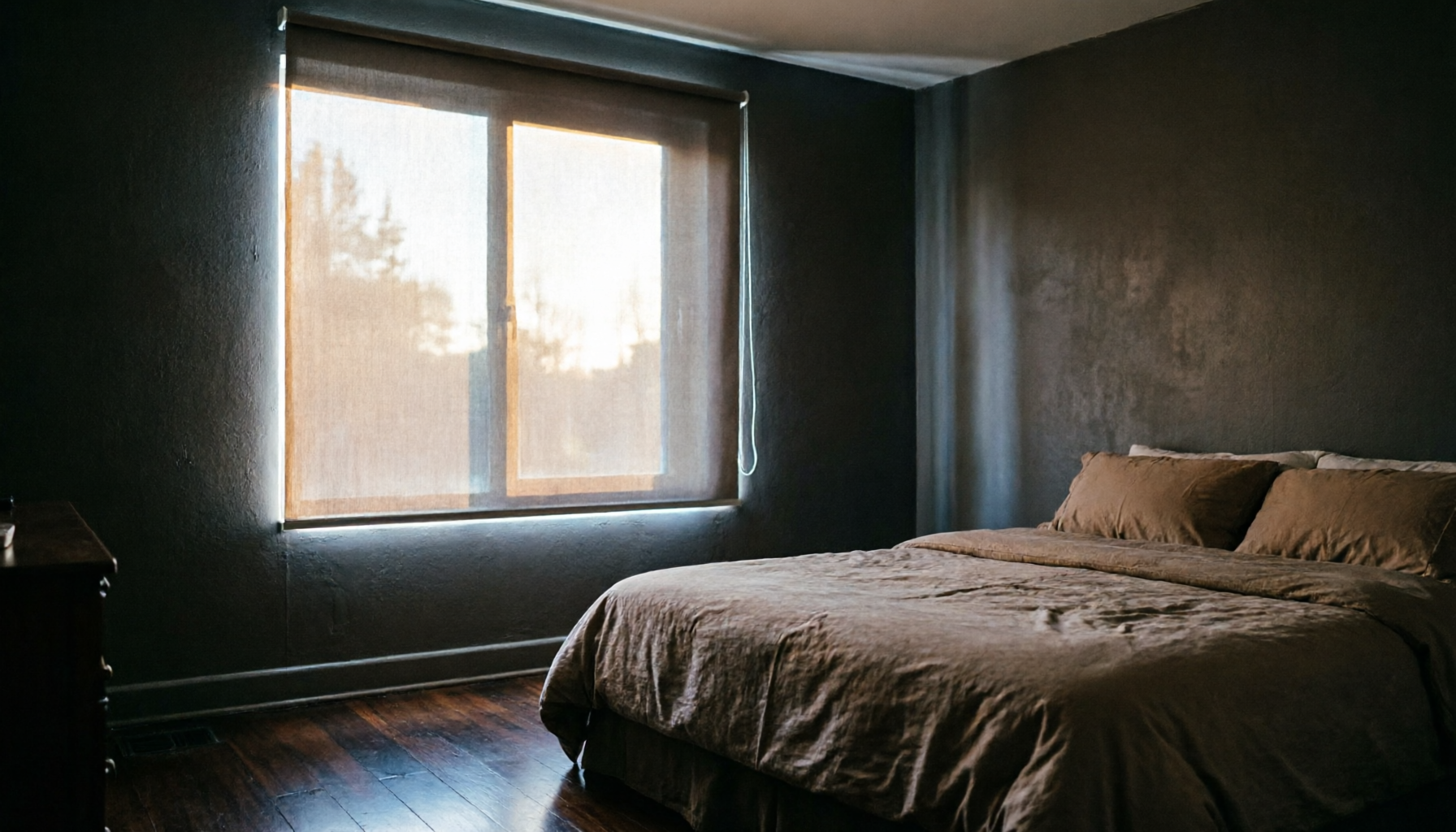
An inside-mounted blind must be narrower than the opening to operate, so there is a gap at each side by design. On a sunlit elevation those two slots project bright lines across the room and are the dominant complaint in "my blackout blind isn't blackout" cases.
Fixes, in order of effectiveness: side channels (an aluminium track that captures the fabric edge), a zip-retained system, an outside mount with generous overlap, or accepting the gap and calling the product room-darkening rather than blackout.
#### 2. Top gap
Light passes over the roller or through the headrail area, especially on inside mounts where the rolled fabric sits away from the reveal face.
Fixes: a closed headbox (cassette) with a light seal, an outside mount that positions the roll above the opening, or a pelmet detail in the ceiling.
#### 3. Bottom gap
The bottom bar rarely seals perfectly against a sill, and on outside mounts it hangs in front of the wall with a gap behind.
Fixes: extending the drop well below the opening on outside mounts, a bottom seal or brush strip, or a sill-level channel end.
#### 4. Joins and multiple blinds
Wide openings covered by two blinds leak between them. Hotel rooms with a blind plus a curtain leak where the two systems meet.
Fixes: a deliberate overlap between adjacent blinds, a shared headbox, or a single wider unit where the drive can handle it.
### The specification ladder
| Level|Specification|Realistic result| | ---|---|---| | 1|Blackout fabric, inside mount, no channels|Room-darkening. Visible light lines at the sides.| | 2|Blackout fabric, outside mount with overlap|Good. Most residential bedrooms are satisfied here.| | 3|Blackout fabric + side channels + cassette headbox|Very dark. The normal hotel standard.| | 4|Level 3 + bottom seal + no joins + light-sealed perimeter|As close to full darkness as a window covering achieves.|
Choose the level from the use case rather than from the fabric sample. A guest room that must be dark at 09:00 in July is a Level 3 problem regardless of how opaque the fabric is.
### Terminology: blackout, room-darkening, dimout
These words are used loosely, and the confusion is commercially expensive:
- Blackout fabric — the fabric itself passes essentially no light, usually through an opaque coating or a bonded construction.
- Room-darkening / dimout — significantly reduces light without full opacity, or a blackout fabric installed in a way that leaks.
- "100% blackout" — a claim about the fabric that customers hear as a claim about the room. This mismatch is the single largest source of complaints in this category.
Practical advice for resellers: describe the installed system, not the fabric. "Blackout fabric with side channels and cassette — designed for near-total darkness" sets an expectation you can meet. "100% blackout blind" does not.
### Hotel and hospitality specifics
Hospitality is where this gets tested hardest, because guests judge a room by whether they can sleep.
- Side channels are effectively mandatory in a room where the sun hits the window in the early morning.
- The curtain-plus-blind combination is common, but the two must be detailed together; a blackout curtain in front of a leaking blind still shows light at the top and sides.
- Consider the corridor side too — light under the entrance door and from bathroom areas defeats a perfectly detailed window.
- Maintenance access matters. Side channels complicate fabric replacement; ask how a damaged fabric is changed without removing the channels from the wall.
- Motorised operation in guest rooms should have a documented manual override — a guest unable to close a blind at 22:00 will call reception.
### The physics worth knowing
A blackout fabric stops light through its surface. It does not stop light around it, and it does not stop light reflecting into the room off a bright sill or a light-coloured reveal that is itself lit through a side gap. This is why:
- A gap of a few millimetres beside a sunlit window produces a surprisingly bright line — the light source is extremely intense relative to a dark room.
- Dark-coloured channels and reveals perform better perceptually than white ones, because they scatter less of whatever leaks.
- Two small gaps in different places are worse than one larger gap in a shaded position; position matters as much as size.
### What to ask any supplier
1. "Is this quoted as a blackout fabric or a blackout system?"
2. "What side channel options exist, and what is the resulting side gap?"
3. "Is a cassette or closed headbox available, and does it include a light seal?"
4. "What overlap do you recommend for an outside mount at this window size?"
5. "For wide openings, is this one blind or two, and how is the join detailed?"
6. "How is a damaged fabric replaced when side channels are fitted?"
7. "For hotels: what is the manual override on motorised units?"
### Frequently asked questions
Is a blackout roller blind enough on its own? For a bedroom that only needs to be dim, usually yes. For genuine darkness — a shift worker, a nursery, a hotel guest room — no; it needs channels or a well-overlapped outside mount.
Do cellular/honeycomb shades come in blackout? Yes, with a blackout fabric, and they add thermal performance. The same four light paths apply, so the same detailing decisions follow.
Are side channels visible? Yes — they are a visible aluminium track at each side, usually matched to the frame colour. That is the aesthetic price of darkness, and it is why some projects prefer a generously overlapped outside mount instead.
Can curtains alone deliver blackout? Blackout-lined curtains reduce light substantially but leak at the top and sides unless detailed with a pelmet and return-to-wall tracks. A blind for the seal plus curtains for the look is the usual hospitality answer.
Written by the engineering team at GRAND HOMEDECOR (Guangdong Grand Homedecor Technology Co., Ltd.). We quote blackout as a system — fabric, channel, headbox and mounting detail together — so the specification matches the darkness the project actually requires.
Related Products
Plantation Shutters
Premium hardwood shutters for living rooms and bedrooms with adjustable light control.
Roller Blinds
Minimalist roller shades with blackout, sunscreen, and sheer fabric options.
Honeycomb Shades
Energy-efficient cellular shades with superior thermal insulation.
Need Help Choosing the Right Window Treatment?
Our team can help you select the best products for your project. Get a free consultation or request a sample today.